
Green Energy Corridor Phase-III: Rs 1.86 Lakh Crore Plan for Grid and Battery Storage
Updated: 2 October 2026 | UPSC: GS III - energy, infrastructure, environment
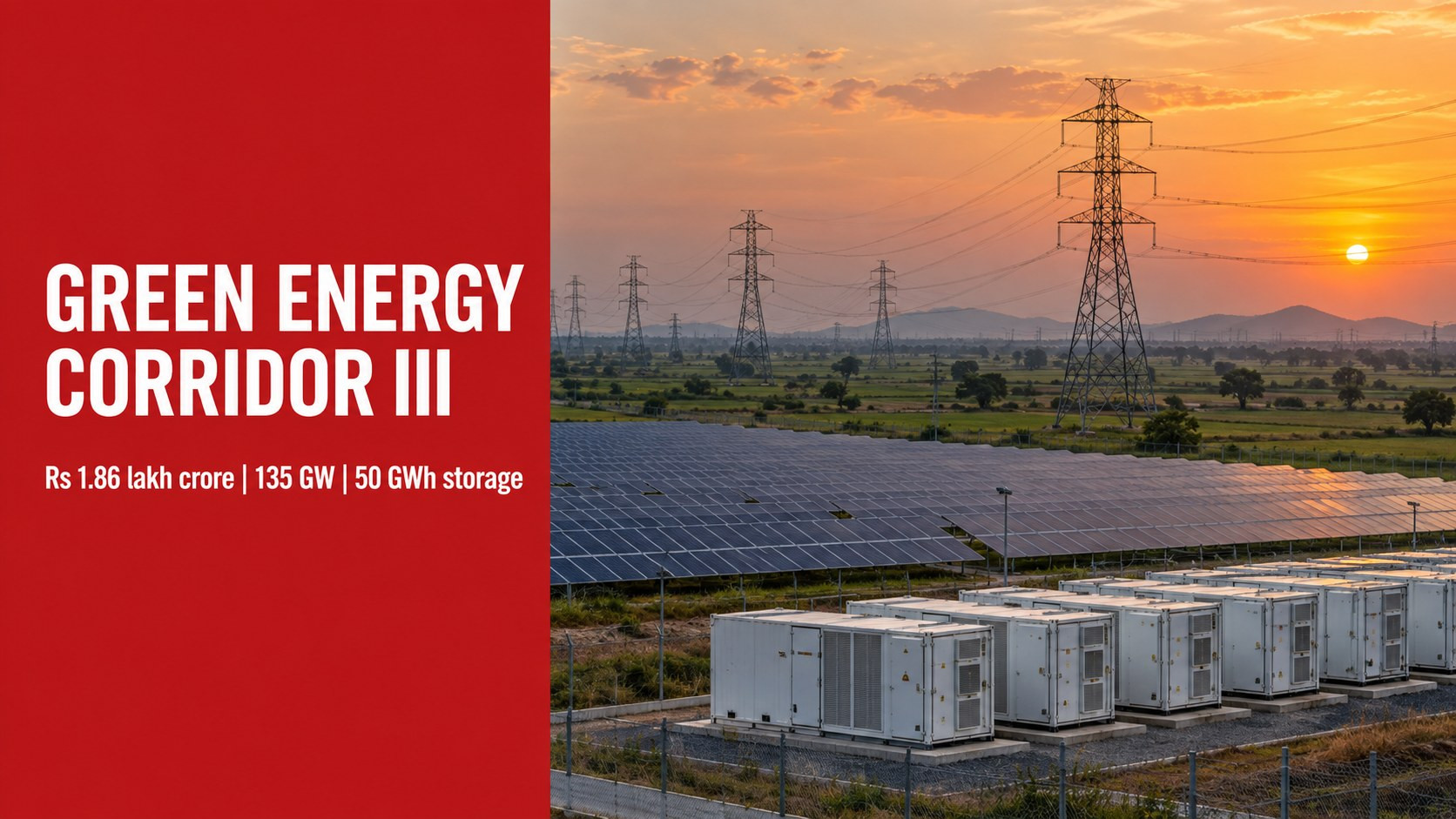
AI-generated illustration. Not a photograph of any specific project.
On 30 September 2026 the Union Cabinet approved the Green Energy Corridor Phase-III (GEC-III) scheme. It strengthens state-level power transmission so more renewable electricity can reach consumers, and it adds large-scale battery storage to handle the gaps and spikes of solar and wind power.
Key numbers
| Item | Official figure |
|---|---|
| Total outlay | Rs 1,86,405 crore |
| Intra-State Transmission System (InSTS) component | Rs 1,36,378 crore |
| Battery Energy Storage Systems (BESS) | Rs 50,000 crore for 50 GWh |
| Central Financial Support | Rs 54,082 crore |
| Renewable power to be evacuated | Up to 135 GW |
| Target completion | FY 2032-33 |
| Linked national goal | 900 GW non-fossil capacity by 2035 |
What the scheme does
- Transmission: It builds and upgrades the intra-State grid, the lines inside a state that carry power from renewable plants to substations and demand centres.
- Storage: It supports 50 GWh of batteries at renewable-developer ends or other important grid locations. This addresses intermittency, congestion, peak-hour curtailment and non-solar-hour demand.
- Central support: Central Financial Assistance offsets intra-State transmission charges, which the release says helps keep power costs down for end users.
How projects are implemented
- Greenfield (new) projects: Tariff Based Competitive Bidding (TBCB).
- Brownfield upgrades and network strengthening: Cost Plus Basis (CPB).
- Implementing agency: State Transmission Utilities.
- Private role: Transmission Service Providers under a Build-Own-Operate-Maintain (BOOM) model.
UPSC angle
- Prelims: Know the difference between inter-State and intra-State transmission, and between GEC-III and the earlier phases. Do not confuse the Rs 1,86,405 crore outlay with the Rs 54,082 crore central support.
- Mains (GS III): Renewable targets only help if the grid can carry the power. Transmission bottlenecks, curtailment and storage are the practical constraints. Competitive bidding aims at cost efficiency, while state utilities' finances and project delays remain the risk.
- Climate link: The scheme supports the 2035 non-fossil capacity goal and long-term energy security.
Practice question
Mains: "Expanding renewable capacity is not enough without grid and storage investment." Discuss with reference to GEC-III. 150 words.
Note: Figures come from the official PIB release of 30 September 2026. Targets are plans, not delivered capacity.
Sources
Plan your UPSC revision



.png)

Post a Comment