
AI for Agri-Food Systems: India's Role in a UN Initiative | UPSC Current Affairs
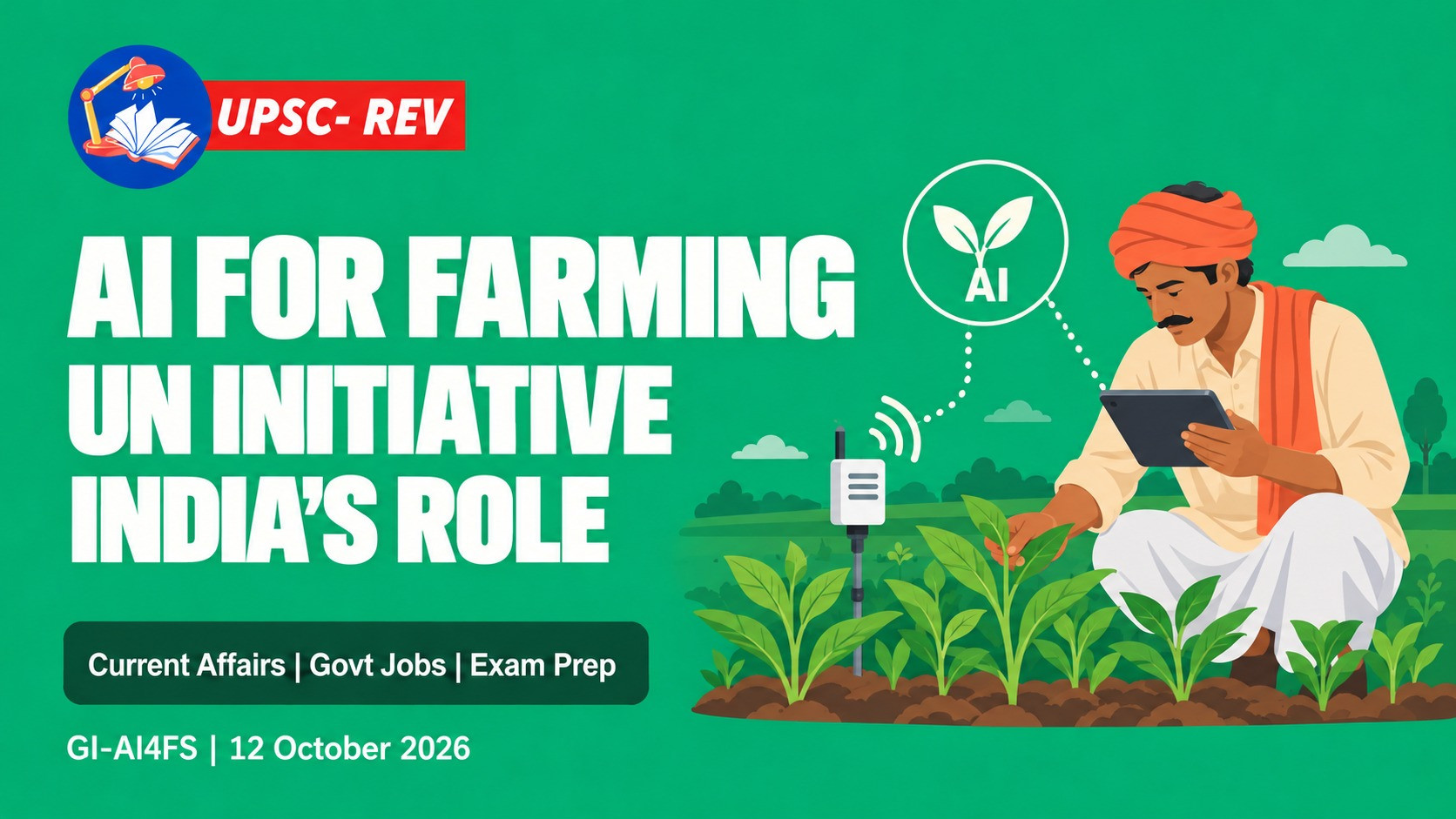
UPSC-REV | 12 October 2026 | Agriculture, technology and global cooperation
Artificial intelligence in agriculture is moving beyond individual apps towards a wider question: how can connected technologies work responsibly across farms, food supply chains and countries?
An official PIB release dated 10 October 2026 reports that India's Telecommunication Engineering Centre (TEC), Department of Telecommunications (DoT), jointly with the Indian Council of Agricultural Research (ICAR), hosted the second meeting of the UN Global Initiative on AI for Agri-Food Systems (GI-AI4FS) alongside India Mobile Congress 2026.
For UPSC, this connects agricultural productivity, digital infrastructure, international institutions and technology governance. It is a coordination initiative, not a newly announced farmer subsidy or recruitment scheme.
What is GI-AI4FS?
The initiative is coordinated by the International Telecommunication Union (ITU) in close collaboration with the Food and Agriculture Organization (FAO), the International Fund for Agricultural Development (IFAD) and the World Food Programme (WFP).
The official release describes its focus as responsible AI use, trustworthy and interoperable farmer-centric solutions, international cooperation on governance and standards, and ways to turn innovation into practical applications.
Interoperability means different systems can work together. In agriculture, a sensor, a data platform and an advisory service should be able to exchange useful information rather than operate as isolated tools. This is an explanatory example, not a technical standard adopted at the meeting.
Why are telecom institutions involved in farming?
AI needs information. Connected sensors, weather stations, drones and satellite-based systems can help collect it. Digital connectivity allows information to move between devices and services, while AI-enabled analytics can help interpret it.
This explains the relevance of TEC and DoT alongside agricultural research institutions. A useful digital farming service depends on both the agricultural knowledge behind an advisory and the infrastructure that carries it to the farmer.
Applications discussed
| Area | Potential use described in the release |
|---|---|
| Precision agriculture | Use connected data to support more targeted farming decisions |
| Resource use | Improve decisions about agricultural inputs and resource utilisation |
| Crop health | Support early detection of crop diseases |
| Farmer decisions | Help farmers make informed choices using data and analytics |
| Supply chains | Improve traceability and efficiency |
| Post-harvest management | Offer opportunities to reduce losses |
These are potential applications, not measured gains established by this meeting. The release does not announce a verified nationwide reduction in crop losses, an income increase or a completed deployment across Indian farms.
What happened around the meeting?
The meeting brought together around 70 in-person delegates and 25 online participants, including international organisations, government departments, agricultural research institutions, academia, industry and standards development organisations.
It was preceded by an international hackathon on 8-9 October 2026, jointly hosted by TEC, DoT and ICAR at the ICAR campus in New Delhi. Students, researchers, developers and innovators worked on practical challenges in agriculture and food systems. Shortlisted teams then presented their solutions, with recognition of winning innovations.
The meeting also discussed the initiative's proposed governance and coordination structure, Working Group leadership and membership, Terms of Reference, priority areas and initial work streams. Do not read deliberations on a proposed structure as proof that every governance decision or standard has already been finalised.
How to analyse this for mains
Farmer-centred design: A technology should answer an actual farming need. In an answer, examine affordability, usable advice and fit with local conditions rather than assuming that a more complex model automatically helps a farmer.
Trust and responsibility: Agricultural advice can affect livelihoods. Reliable data, clear accountability and a way to question or correct advice are useful issues to discuss. These are analytical considerations, not safeguards independently verified in this announcement.
Access and inclusion: Connectivity, device access, language and digital skills can affect who benefits. An answer should ask whether small and marginal farmers can use the service, not merely whether the technology exists.
Standards and cooperation: Interoperable systems can help different institutions and providers work together. International cooperation also raises questions about data governance, participation and how global priorities relate to local farming needs.
UPSC relevance
GS Paper III: Agriculture, science and technology, digital infrastructure, food supply chains and resource efficiency.
GS Paper II: International institutions and cooperation, governance and inclusive public-service delivery.
Prelims revision: GI-AI4FS; ITU as coordinator; collaboration with FAO, IFAD and WFP; Indian hosts TEC/DoT and ICAR.
Mains practice: How can AI and IoT support farmer-centric agriculture? Discuss the roles of connectivity, interoperability and responsible governance. (150 words)
Quick takeaway
The story is about building cooperation for responsible agricultural AI. Remember the institutional arrangement and the potential uses, but keep a clear line between a promising innovation, a demonstrated pilot and proven large-scale outcomes.
Official source
Plan your preparation
Explore preparation support on Topmate



.png)

Post a Comment