
Bharat 6G Symposium 2026: Five MoUs, Nine White Papers and the New Delhi Declaration for UPSC
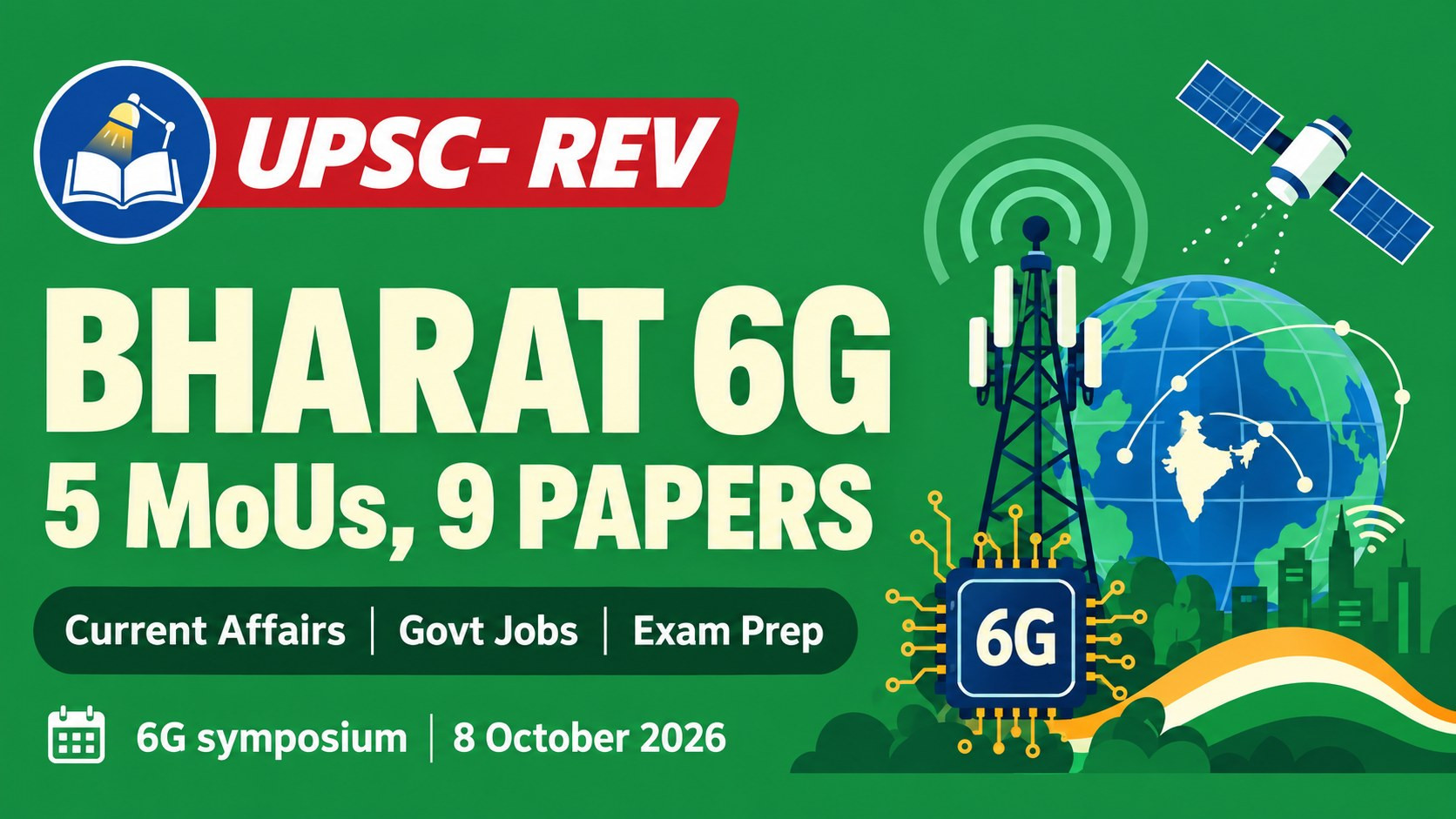
UPSC-REV | 9 October 2026 | Science, technology and digital infrastructure
The Bharat 6G Alliance exchanged five new Memoranda of Understanding and released nine Working Group white papers at the 3rd International Bharat 6G Symposium. A PIB release dated 8 October 2026 also records a joint report reviewing one year of progress on the New Delhi 6G Declaration.
For UPSC, this is a story about research cooperation, technical standards and digital infrastructure. It is not an announcement that commercial 6G services have launched in India.
What happened?
The symposium is being held from 7-9 October 2026 at Yashobhoomi, Dwarka, New Delhi. Communications Minister Jyotiraditya M. Scindia inaugurated it on 8 October, according to PIB.
The event brings together policymakers, telecom operators, technology alliances, industry, academia and research institutions. Its discussions cover standards, trials and testbeds, spectrum, AI-native networks, sustainability and international cooperation.
Five new partnerships
The Bharat 6G Alliance exchanged MoUs with:
- GSMA
- one6G Association
- GTI Alliance Ltd
- 6G Industry Forum (6GIF)
- VoICE
PIB says these add to 10 global and two domestic MoU/MoI collaborations already in place, taking the broader partnership network to 17 collaborations.
The purpose is cooperation in research, innovation, standardisation, technology development and deployment. An MoU records cooperation; it does not establish that a commercial network has been deployed or that all promised outcomes are complete.
What do the nine white papers cover?
| White-paper subject | UPSC connection |
|---|---|
| Technology landscape and roadmap for R&D, platforms and trials | Domestic research capability and testing |
| Integrated Sensing and Communication (ISAC) | Emerging communication technologies |
| Fixed Wireless Access from 5G to 6G | Broadband access |
| Optical technologies for 6G | Network infrastructure |
| IMT spectrum readiness towards 2030 and beyond | Spectrum planning and standards |
| Sustainable 6G | Energy use and environmental goals |
| Cellular and Wi-Fi synergy | Inclusive connectivity |
| Captive Non-Public Network (CNPN) | Enterprise-network applications |
| Security for 6G | Trust and network security |
The release confirms that the white papers were issued and identifies their subjects. Their publication is not, by itself, evidence that each technology is commercially mature. This article uses the official announcement, not an independent technical assessment of the full white papers.
The New Delhi Declaration: principles and progress
The joint report is titled "Progress towards the 6G Principles of the New Delhi Declaration: Actions, Outcomes and Outlook - First Edition, October 2026." It takes stock of actions and outcomes reported by participating MoU partners since the declaration was endorsed at the 2025 symposium.
The declaration provides a common framework for a 6G ecosystem that is:
- Secure and resilient.
- Open and interoperable.
- Inclusive and sustainable.
Its emphasis is international cooperation in research, innovation and standardisation. The progress report is a review of participating partners' reported work, not a claim that every declaration principle has already been achieved.
Why standards matter
The release places standardisation alongside research, trials and intellectual property. For a mains answer, the question is larger than which company builds a faster radio: how can networks and devices work together, remain secure and reach users across different contexts?
Interoperability, trust, affordable access and sustainability therefore belong in the discussion. These are policy questions suggested by the declaration's principles, not additional services guaranteed by the five MoUs.
UPSC relevance
GS Paper III: Emerging technologies, telecom infrastructure, domestic innovation, cybersecurity and intellectual property.
GS Paper II: International cooperation and the institutions involved in technology governance.
Prelims: Bharat 6G Alliance, the symposium, the five partner organisations, ISAC and CNPN, and the New Delhi Declaration's principles.
Mains practice: Why should India participate in international standardisation while building domestic telecom research capability? Discuss with reference to the Bharat 6G initiative. (150 words)
A balanced assessment
Partnerships and technical papers can help organise research and cooperation. Turning them into useful technology requires testing, standards alignment, secure implementation and viable applications. Those are analytical conditions, not outcomes proved by this announcement.
Avoid unsupported speed comparisons, commercial-launch dates or claims that 6G will immediately replace 5G. The PIB release is about ecosystem preparation and collaboration.
Quick revision
Five MoUs; nine white papers; 17 total collaborations; one-year progress report on the New Delhi Declaration. Remember secure, resilient, open, interoperable, inclusive and sustainable. Research cooperation is not the same as commercial rollout.
Official source
PIB: Bharat 6G Alliance signs five MoUs and unveils nine white papers, 8 October 2026
Plan your preparation
Explore preparation support on Topmate



.png)


Post a Comment